

-
Overview
Kindergarten students in SFUSD engage in 50-60 minutes of daily math instruction that provides a strong sense of agency and supports their identities as mathematicians. Through play and exploration, math lessons develop conceptual understandings of composing and decomposing numbers and shapes (putting numbers and shapes together and pulling them apart). Kindergarten students also develop procedural fluency within 5.
-
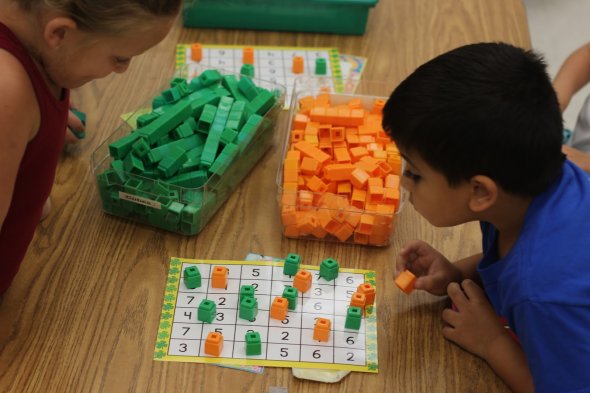
During math instruction, students are engaged in a number of instructional contexts and routines: math talks, counting and calendar routines, and learning stations. Math talks feature subitizing (recognizing a number of objects without counting) and flexibility with numbers. In addition, engaging in collaborative tasks and games will result in joyful math learners.
Overview Link to this section
|
Mathematics* |
50 mins every day |
|---|---|
|
Counting & Daily Routines |
10 mins every day. May or may not be connected to the lesson |
|
Math Talk |
10-15 mins, 3-5 days per week. May or may not be connected to the lesson |
|
Lesson |
20 mins every day |
|
Learning Stations |
10-20 mins, 3-5 days per week. May or may not be connected to the lesson |
*The components listed may be taught at different times of the day (i.e. Extend your Morning Meeting to include Counting and Daily routines in the form of daily calendar).
Priority Standards Link to this section
What students will know, what students will do, and what thinking skills students will develop to apply and transfer mathematical understandings that endure within the discipline, leverage deeper understandings, and/or support readiness for success at the next grade level.
In Kindergarten focus on these critical areas:
-
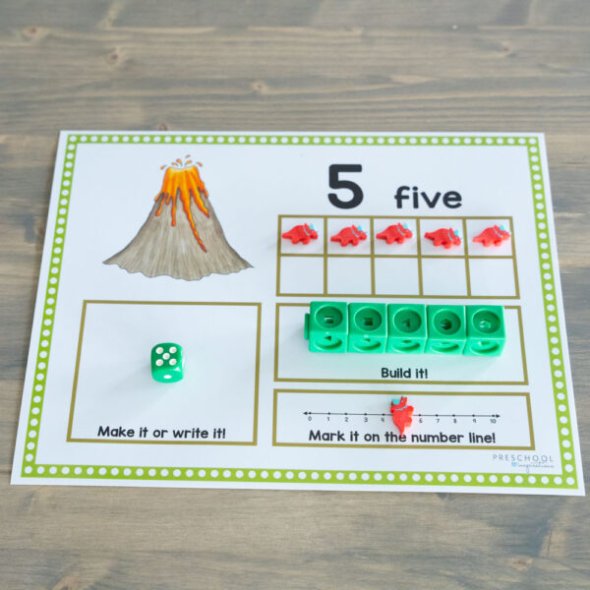
Representing and comparing whole numbers, initially with sets of objects
- Knowing number names and the count sequence.
- Counting to tell the number of objects.
- Comparing numbers.
- Understanding addition as putting together and adding to, and understanding subtraction as taking apart and taking from.
- Working with the numbers 11–19 to gain foundations for place value.
-
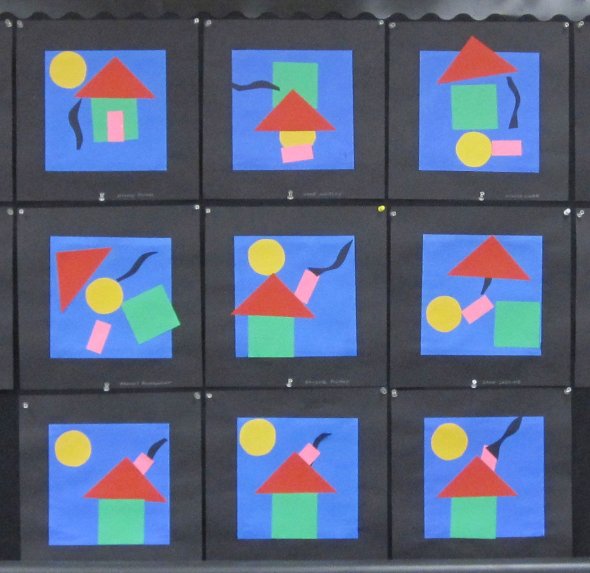
Describing shapes and spacial relationships.
- Identifying and describing shapes.
- Analyzing, comparing, creating, and composing shapes.
-
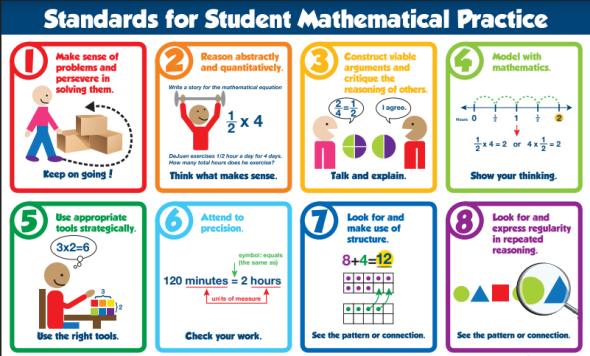
Behaviors of Mathematicians
- Make sense of problems and persevere in solving them
- Reason abstractly and quantitatively
- Construct viable arguments and critique the reasoning of others
- Model with mathematics
- Use appropriate tools strategically
- Attend to precision
- Look for and make use of structure
- Look for and express regularity in repeated reasoning
Instruction: Signature Elements Link to this section
Below are signature elements of SFUSD Math instruction that students should experience regularly throughout Kindergarten as they develop as mathematicians.
-

Math Norms
- Mistakes help us grow.
- We talk to each other about math.
- We can show math ideas in different ways.
-

Groupwork Feedback
Groupwork feedback is a strategy to publicly recognize the class norms and math focus of students as they work in groups. Group work is loosely defined to include partners, trios, or larger group sizes. The teacher takes public notes about the quality of the group work and the quality of the mathematical discussions. This feedback should focus on the specific nature of groupwork interactions as well as target mathematics of the lesson rather than general positive reinforcement.
-
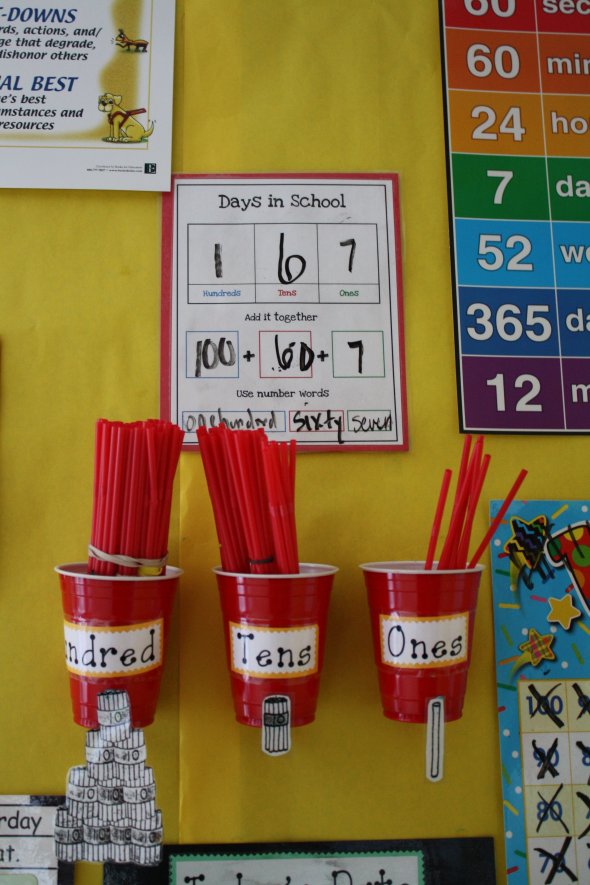
Routines
Daily routines are the cornerstone of the mathematics curriculum in the early primary grades. This structure provides opportunities for deeper learning that requires students to continuously revisit potentially abstract concepts in a concrete context. Although the basic routine structures will stay the same throughout the year, the complexity and focus will change and develop over time.
-
Learning Stations
Learning stations are an activity-based structure that provides students with opportunities for student-led engagement with, or extensions of, previously taught concepts. Stations can also be used to explore new manipulatives/tools before they are used in a formal lesson. You can use this time to observe students, pull small groups for targeted instruction or formative assessment, or teach the lessons in small groups.
Materials
Below are items you should have to support your students' Math instruction. If you are missing anything from the list, please first contact your site administrator or designated support. If they are unable to resolve the issue promptly, please contact your site’s liaison from the C&I Math Department.
Student Classwork and Homework booklets are centrally printed and provided by the SFUSD Math Department. Here are PDFs of the Student Pages.
Full Math Manipulative List : Manipulatives have already been provided to each site and should remain with the classroom.
Units
Unit Design
SFUSD units are designed around four tasks. These tasks offer all students opportunities to engage in meaningful and rigorous mathematics that allow for the development of the Standards for Mathematical Practice. They give information about how students are learning the core concepts and skills of the unit.
All tasks are used for formative assessment—gathering information about what students know and are able to do—but they are not tests. The Entry, Apprentice, and Expert Tasks allow for student collaboration and individual accountability without being graded based on an expectation of mastery. The Milestone Task can be used as an individual assessment for grading students.
 |
|---|
- Entry Task: What do you already know?
- Apprentice Task: What sense are you making of what you are learning?
- Expert Task: How can you apply what you have learned so far to a new situation?
- Milestone Task: Did you learn what was expected of you from this unit?
Units
| Unit | Description | Orientation | |
|---|---|---|---|
| The first week of school is focused on setting up the classroom culture for the year and developing routines that support the development of the Standards for Mathematical Practice. Particular attention is paid to MP6, Attend to precision. (5 days) | |||
 |
Two- and three-dimensional objects can be described and named. In this unit, the focus is on describing the difference between two-dimensional (flat) and three-dimensional (solid) objects. (10 days) | Unit K.1 Orientation | |
 |
A number has a word and a symbol that corresponds to the quantity. Quantities can be sequenced and compared. The focus in this unit is on the numbers 0–10. (17 days) | Unit K.2 Orientation | |
 |
Smaller numbers can be composed into larger numbers and larger numbers can be decomposed into smaller numbers. The focus in this unit is the combinations of numbers to 10. (13 days) | Unit K.3 Orientation | |
 |
Two-dimensional objects can be described, classified, and analyzed by their attributes. 2-D shapes can be used to build composite shapes. (12 days) | Unit K.4 Orientation | |
 |
Real-world problems involving joining can be solved using addition. Adding quantities greater than zero gives a sum that is greater than any addend. (15 days) | Unit K.5 Orientation | |
 |
Real-world problems involving separating, or comparing can be solved using subtraction. Subtraction can be seen as taking away. (15 days) | Unit K.6 Orientation | |
 |
3-dimensional objects can be described, classified, and analyzed by their attributes. Simple shapes can be combined to create complex shapes. (11 days) | Unit K.7 Orientation | |
 |
A number has a word and a symbol that corresponds to a quantity. Quantities can be sequenced and compared. The focus in this unit is on the numbers 11–20. (11 days) | Unit K.8 Orientation | |
 |
The base-ten system builds upon units of ten. The teen numbers constitute 10 ones and some more ones. (10 days) | Unit K.9 Orientation | |
 |
Some attributes of objects are measurable and the measurements can be compared. The focus in this unit is on recognizing the same attribute in different objects and determining which object has more or less. (10 days) | Unit K.10 Orientation | |
 |
Each number has a word and a symbol that corresponds to its quantity. Quantities can be sequenced and compared. The focus of this unit is on discovering the base ten pattern of the counting numbers. (10 days) | Unit K.11 Orientation | |
 |
Real-world problems involving several kinds of situations can be solved using addition or subtraction. These situations include: Add To - Result Unknown; Take From - Result Unknown; Put Together/Take Apart - Total Unknown; and Put Together/Take Apart - Both Addends Unknown. The focus in this unit is fluency with combinations within five. (10 days) | Unit K.12 Orientation |

Lesson Structure and Core Math
|
|
|
|
|
|
|
|
|
|
|
|
|
|
|
|
|
Planning Guide
This calendar is intended as an instructional guide to help with year-long planning. There is no expectation that you teach a particular lesson on a particular day. Each unit is set within a “window” of time that gives you some flexibility.
Reflection Questions Link to this section
- How are students' developmental needs, communities, and experiences being reflected and honored, or how could they be?
- What opportunities do you see for developing equitable access & demand, inquiry, collaboration, and assessment for learning?
- What are the implications for your own practice? What strengths can you build upon? What will you do first?
Want More?
Standards
More Resources
- The SFUSD Math Core Curriculum Kindergarten Overview includes the priority standards, the scope and sequence of units and standards, the unit design, class norms, key instructional strategies, and icons used throughout the curriculum to support planning.
- Assessment resources (in addition to the embedded formative assessment in the Core Curriculum)
Contact the Math Team:
This page was last updated on April 27, 2023