

Abraham Lincoln High School - At a Glance Link to this section
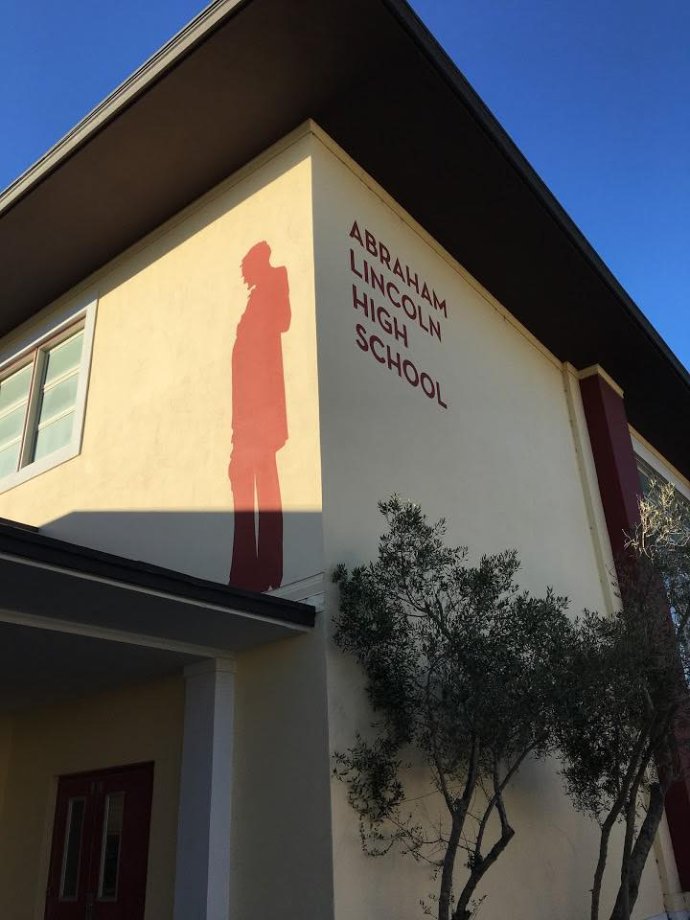
|
Abraham Lincoln High School A California Distinguished School
2025-2026 School Profile
Enrollment: 2110 |
Community
Established in 1940, Abraham Lincoln High School is located in the western sector of San Francisco. The student body is economically, socially and ethnically diverse with the majority being Asian students. Most of our students were born in a foreign country and English is not their first language. The 2,000 plus students hail primarily from the Sunset District, a largely residential neighborhood of San Francisco. The school supports extra-curricular activities in its 60 clubs and 21 athletic teams.
Advanced Placement & Honors courses
AP World History |
AP Calculus AB |
AP Computer Science Principals |
Students are only allowed to take up to three advanced placement classes. Only thirty-five students can enroll per section, thus the number of students who can take these courses per academic year is limited. Selection is randomized.
Career Academy Offerings
Students must apply to be part of these career pathways. Each cohort is limited to thirty students to gain a full experience except for Business Academy and the Digital Media Design Academy. These two academies have two cohorts per grade level.
Business Academy:
Students are introduced to the world of business and finance while becoming proficient in the Microsoft Office Suite.
10th grade – Principles of Finance
11th grade – Accounting/Global Economy
Summer - Paid internship
12th grade - Ethics in Business/Market & Entrepreneurship and CCSF classes
Digital Media Design Academy (DMD):
Digital Media Design Academy (DMD): Students use the industry standard digital creation software suite, Adobe Creative Cloud, learning Adobe Photoshop, Adobe Illustrator, and Adobe Premiere Pro. Students work on team collaborative projects throughout the Program to learn video and animation skills, as well as learning graphic design, audio production, and logo/poster design. Students prepare to do a paid summer internship.
Course Sequence:
10th grade – AME Arts Media & Entertainment 2
11th grade – AME Arts Media & Entertainment 3
Summer (between junior & senior years) OPTIONAL, but highly recommended, Paid Internship in Digital Media
12th grade – AME Arts Media & Entertainment 4 Honors
Teacher Academy (TA):
This three-year elective program examines 1) the history of education, 2) a comprehensive overview of child development, and 3) current issues in family and community services and sociology. Students intern in off-campus Elementary School classrooms and on-campus Special Education classrooms to develop their leadership and critical thinking skills; to apply their in-class studies in real life work-based learning opportunities; and to become more empathetic human beings both inside and outside of the classroom. Students also attend field trips, meet and learn from visiting guest speakers, and regularly collaborate in research- and presentation-based classwork. Our courses prioritize the personal, professional, and academic development of our students so that they are prepared to contribute positively to their communities and pursue careers in Education, Child Development, and Family/Community Services.
10th grade – Introduction to Education
11th grade – Child Development
12th grade – Child, Family, and Community Services (Semester 1: Post-Grad Preparation)
Green Academy:
Through hands-on and field work experiences students will gain content knowledge and work based learning for careers in the energy, environmental and utilities sector.
10th grade – Environmental Field Studies
11th grade – Green Engineering
12th Grade – Green Economics & AP US Politics & Government
Paid internships are available over summer and during the school year at a variety of green companies & organizations.
Public Health Pathway:
The Public Health Program is focused on understanding and sustaining mental, social, and community health. Throughout the course of the pathway, students will examine the historical, political and cultural influences on health outcomes as well as how to promote life and health through the organized efforts & informed choices of society, organizations, public & private, communities and individuals. During their time in the pathway, students will take elective courses that will ask them to analyze the connections between race and class as determinants of health outcomes in addition to systemic issues throughout institutions to improve the well-being of individuals, interpersonal relationships, and support from institutions.
Other Academic Programs
AVID:
The mission of AVID is to ensure that all students, specifically the least served students who are in the middle range will be eligible to enroll in a four-year college, take and complete rigorous college preparatory classes (Advanced Placement and Honors), complete all University of California A-G requirements, enter mainstream activities, and become educated and responsible participants and leaders in a democratic society.
Biotech Pathway:
The Biotechnology Pathway program emphasizes the applications, implications, and limitations of current biotechnology. The courses train students in several laboratory techniques currently used in biotech labs throughout the world. The program offers two years of biotech courses: Principles of Biotechnology 1/2 for sophomores, juniors and seniors, and Principles of Biotechnology 3⁄4 for juniors and seniors who have completed the first year of the program.
Graduation Requirements
| English | 40 Credits |
| History/Social Science | 30 Credits |
| Mathematics | 30 Credits |
| Lab Science | 20 Credits |
| Visual and Performing Arts | 10 Credits |
| World/Foreign Language | 20 Credits |
| Physical Education | 20 Credits |
| Health Education | 5 Credits |
| Career Education | 5 Credits |
| Electives | 50 Credits |
Class Rank
Class rank does not appear on the transcript and will not be available this academic year.
Grading: A= Superior B= Above Average C= Average D= Below Average F= Failed
All counselors may be reached at (415) 759-2713
This page was last updated on November 12, 2025