
Introduction Link to this section
What is the Standard Response Protocol? Link to this section
What is the Standard Response Protocol? Link to this section
San Francisco Unified School District uses the Standard Response Protocol (SRP) to ensure clear, consistent communication during emergencies across all schools.
SRP is a nationally recognized framework developed by the I Love U Guys Foundation and is used by schools and public safety agencies throughout the country. Its purpose is to provide shared, plain language so students, staff, families, and first responders understand what actions are being taken during an incident.
What SRP Is — and What It Is Not
SRP is:
- A communication framework
- A shared set of standard actions and directives
- Designed to reduce confusion during emergencies
- Used across all district schools for consistency
SRP is not:
- A prediction tool
- A guarantee of outcomes
- A description of every possible scenario
- A replacement for parent notification systems
SRP is a communication framework that helps schools communicate clearly and consistently while emergency response is underway.
Why SRP Matters for Families Link to this section
During an emergency, information can change quickly. SRP allows schools to communicate what action is being taken using common language that families can recognize and understand.
When families receive an emergency message, it may reference an SRP action. Knowing what those actions mean helps families:
- Quickly understand the general situation
- Avoid confusion or misinformation
- Know when family action is or is not needed
The Five Standard Response Protocol Actions
Link to this section
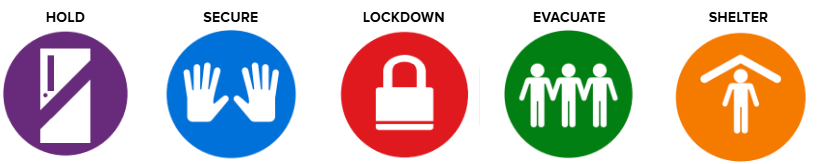
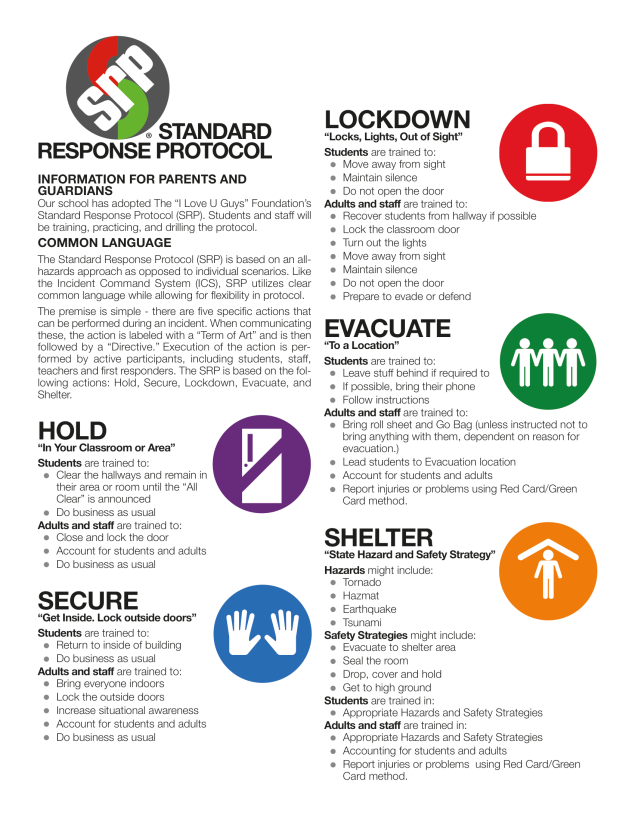
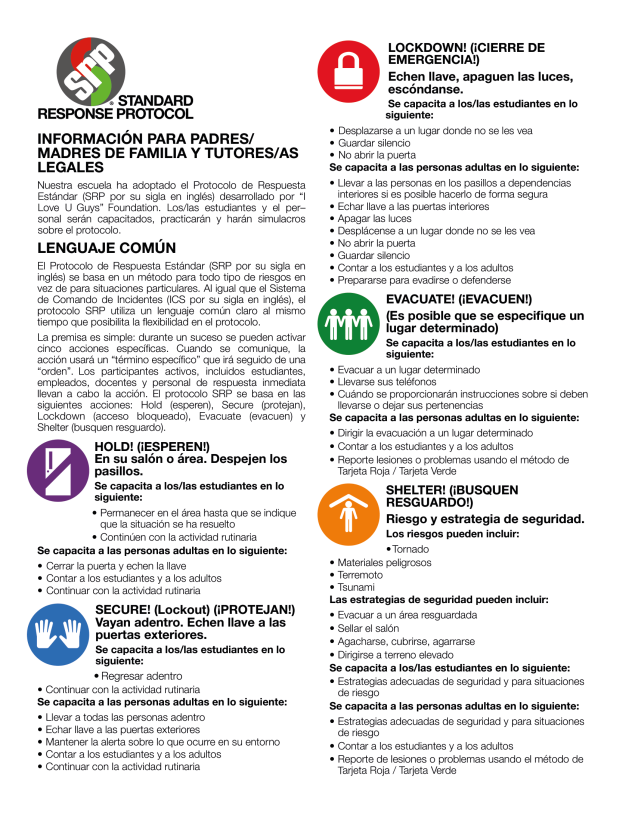
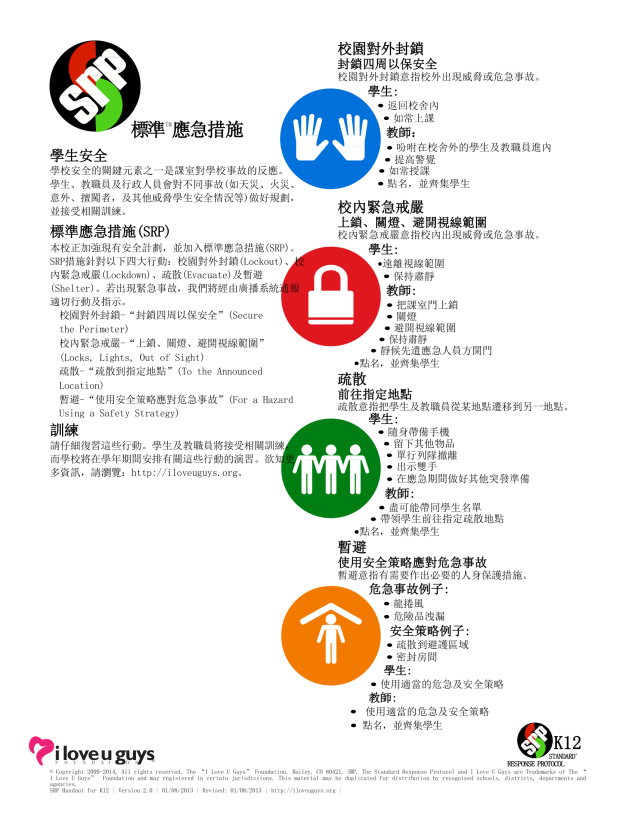
SRP uses five standard actions. Only one action is used at a time, based on the situation.

Used to keep hallways and common areas clear during short-term situations, such as a medical emergency or maintenance issue. Instruction can continue while movement is temporarily limited.

Used when a potential concern exists outside the school building. Students and staff move indoors, exterior doors are locked, and normal activities continue inside.

Used when there is a serious threat inside or on the school premises. Doors are locked, lights are turned off, and occupants remain quiet and out of sight until first responders determine it is safe to resume normal operations.
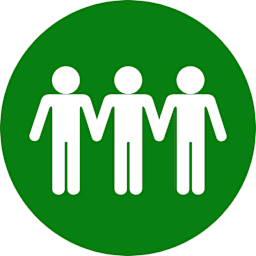
Used when it is safer to leave the building due to conditions such as fire, gas leaks, or unsafe building conditions. Students and staff move to a designated location as directed by school staff or emergency responders.
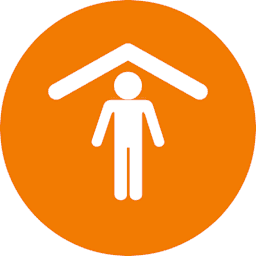
Used for environmental or hazardous conditions, such as earthquakes, tsunamis, severe weather, or hazardous materials. Staff will clearly communicate the specific hazard and the appropriate safety action.
Examples of safety strategies may include:
- Drop, cover, and hold on
- Moving to higher ground
- Sealing a room
- Taking cover away from windows
How SRP Connects to Family Communication
SRP guides on-campus response. Family communication occurs in parallel through official district channels.
During an incident, families can expect:
- Official updates via text and/or School Messenger once information is verified
- Messages that may reference the SRP action in use
- Instructions if family action is required, including reunification details if applicable
After the incident is resolved and depending on the level of emergency, families will be notified either immediately after resolution, or at the end of the school day.
Depending on the level of emergency, family communication may also occur via the following channels:
- Important updates on our website home page www.sfusd.edu
- Status updates on Twitter (@SFUnified)
- Informational updates on radio stations such as KCBS (740AM) and KQED (88.5 FM)
- Updates on 311.org
Citywide information on sfgov.org
What Families Can Do
Families help support effective emergency response by:
- Make sure your child’s Emergency Contact information is up to date with the school’s main office and on ParentVUE. Learn how to update your Emergency Card in ParentVUE at sfusd.edu/emergencycard.
- Relying on official school and district communication
- Know your school’s evacuation site (see your school’s emergency plan in the main office)
- Avoiding campus unless directed
- Keeping contact information current with their child’s school
- Follow us @SFUnified on Twitter
Citywide information on sf72.org
This page was last updated on March 19, 2026