

Introduction Link to this section
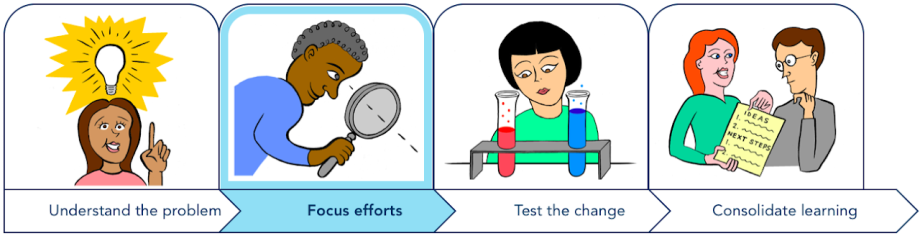
Go to the toolkit for Focus Efforts.
Focus Efforts Link to this section
You can capture your work toward answering the question, "What changes might we make and why?" in the second row of your improvement project charter.
Brainstorm and Prioritize Strategies Link to this section
After you have done some work to understand the problem, you will be ready to generate change ideas. What changes can you make to affect your problem of practice? Where are others achieving success in addressing a similar problem? What has worked for others that you can build on and refine for your context? What ideas surfaced in the context of your empathy interviews, journey mapping or process mapping?
Some other tools you can use to generate ideas include: Brainstorming and Prototyping.
To prioritize among the many ideas that your team has generated, you can use a PICK chart to rate the ease of implementation and size of impact of each.
Articulate Theory of Improvement Link to this section
Once you have identified a change that you would like to implement and test, a Theory of Improvement provides you and your team with a framework to articulate what change you might make for what impact.
You can capture your work in answering the question, "How will we know if a change led to improvement?" in the third row of your improvement project charter:
Define Measures Link to this section
Use your Theory of Improvement to determine what you will need to measure about your implementation and impact. Keep in mind that when testing a change, it will be important to think about measures for both of these. Implementation measures will help you understand whether or not you did what you said you were going to do. Impact measures will help you assess the outcomes of those changes. Use these measures to complete the lower portion of your Measurable Theory of Improvement.
There are additional guidelines and examples of measurement in the Improvement Toolkit.
Set Measurable Goal Link to this section
After identifying an area to prioritize for improvement, turning the abstract goal into a measurable goal statement may require additional information. This often comes in the form of a SMART-E goal which includes these components: Specific, Measurable, Achievable, Relevant, Time-bound, and Equity-driven.
This page was last updated on July 1, 2025