

District Assessments for Families
Link to this section
Star Interim District Assessments
Link to this section
The Star assessments are heavily researched, valid, reliable, and highly correlated to summative state assessments, making them ideal interim measures to monitor progress toward interim district goals in the SFUSD Vision Values Goals and Guardrails.
What are the District Assessments?

The Kindergarten Readiness Inventory (KRI) is administered at the beginning of Kindergarten. The KRI includes readiness measures of literacy, social-emotional learning, fine motor skills, and numeracy. You can discuss with your child's teacher about how to use this information to identify students' strengths and needs as they begin their school careers.

Star assessments are computer adaptive tests in Early Literacy, Reading, and Math that are designed to provide accurate, valid and reliable data for informing standards based instruction and progress monitoring. Star assessments are administered in 20-30 minutes and will be administered to all students in grades K-10.
What are Star assessments?
What are Star assessments?
The Star Assessments are computer adaptive tests created by Renaissance Learning, designed to provide teachers and families information about students' reading and math achievement.
Read Translated Star Info For Families Overviews below to find out more about the purpose and use of Star assessments:
What are computer-adaptive tests?
Star assessments are computer-adaptive tests (CATs). Computer-adaptive tests continually adjust the difficulty of each child’s test by choosing each test question based on the child’s previous response. If the child answers a question correctly, the difficulty level of the next item is increased. If the child misses a question, the difficulty level is decreased. CATs save testing time and spare your child the frustration of items that are too difficult and the boredom of items that are too easy.
For more details, view sample test items for Star Reading and Star Math.
How long does it take to complete a Star assessment?
Star tests are designed to be as efficient as possible. On average, students will complete the Star Math/Star Reading tests in about 20-30 or the Star Early Literacy test in 10-15 minutes. However, some students may require more time.
What are Star assessments used for?
Star assessments provide a picture of a child's current learning in reading and math, and can also be used to monitor your child’s learning growth throughout the year. In addition, Star can help your child’s teacher plan appropriate instruction to address the skills that your child is ready to learn.
How are Star assessments scored?
Star assessments measure proficiency using a scaled score (SS), which is based on the complexity of the questions answered correctly. The Star assessments provide a unified scaled score ranging from 0–1400 which can then be used to identify a students' achievement for the time of year when they took the test. The scaled score can be used to identify how a student is progressing toward grade level expectations: 1) Not Yet Approaching, 2) Approaching, 3) Meeting, 4) Exceeding.
How can I help my child prepare for a Star assessment?
Please communicate with your child’s teacher to learn when they will administer the Star assessments. During this time, it is important for you to encourage your child to try their best on the assessment. Since Star is a general measure of student ability in math or reading, students perform best on the assessment in the same way they perform best in school—when they have had plenty of rest, attend school regularly and have eaten breakfast.
How will I know how my child is doing?
You will receive a Star student report through ParentVue to learn how your child did on the Star tests after each testing window right before Parent Teacher Conference Week: November 18-22 & March 3-7. It is always important to keep open communication with your child’s teacher to learn more about how your child has progressed and what skills they are working on in Reading and Math.
How can I help my child with Reading or Math?
SFUSD staff has created an At Home Resources to Support Student Learning site to provide activities you may do at home with your child to support their reading and math development. These activities are clustered by grade band and also include questions you might ask your child after the activities and learning to support reflection and discussion on what was learned.
When are the District Assessments administered?
| Grade | Assessment | Dates |
| K | Kindergarten Readiness Inventory | Sep 3 - Sep 24 |
| K | Star Early Literacy | Fall: Oct 5 - 30 Winter: Jan 25 - Feb 19 Spring: Apr 19 - May 10 |
| 1-2 | Star Reading & Math | Fall: Oct 5 - 30 Winter: Jan 25 - Feb 19 Spring: Apr 19 - May 10 |
| 3-7 | Star Reading & Math | Fall: Oct 5 - 30 Winter: Jan 25 - Feb 19 |
| 8 | Star Reading & Math | Fall: Oct 5 - Oct 30 Winter: Jan 11 - Feb 4 |
| 9-10 | Star Reading & Math | Fall: Aug 24 - Sept 11 Winter: Jan 11 - Feb 4 Spring: Apr 19 - May 10 |
What is the purpose of the Star Assessments?
What is the purpose of Star Assessments?
Star assessments provide a picture of a child's current learning in reading and math, and can also be used to monitor your child’s learning growth throughout the year. In addition, Star can help your child’s teacher plan appropriate instruction to address the skills that your child is ready to learn. Star assessments are highly correlated to summative state assessments, and used to monitor student's progress toward grade level proficiency from window to window and year to year.
What are Star assessments used for?
Using these results:
- Students can reflect on their own learning and goals.
- Families can support their child at home with their goals.
- Teachers reflect on students' learning and progress to inform instruction.
School/District staff can improve School/District planning and supports.
Read Translated Star Info For Families Overviews below to find out more about the purpose and use of Star assessments:
- Star Early Literacy
- Star Reading
- Star Math
When will results be shared with families?
District Assessment reports are provided to families via ParentVue in mid-November and early March, to align with Parent/Teacher Conference weeks. These assessments provide a snapshot of learning to students, families, teachers, and staff.
Grades 9-10 and K-2 families will also receive a student report in late May / early June via ParentVue. Instructions to access and navigate to the Documents folder (where reports are posted) in ParentVue are available at: https://www.sfusd.edu/services/family-supports-services/family-school-communications/family-portal-parentvue/parentvue-walkthrough
Sample Student Reports - Translated examples of Star District Student Reports are available, and include language regarding how to interpret the report.
How do I interpret the scores on the Star Report?
How do I interpret Star Scores?
After students take the Star Assessments, their results are reported in two primary ways: scaled scores and achievement levels. A scaled score is the student's overall numerical score. These scores fall on a continuous scale that increases across grade levels. Scaled scores can be used to illustrate students' current level of achievement and their growth over time.
Sample Student Reports - Translated examples of Star District Student Reports are available, and include language regarding how to interpret the report.
Using these results:
- Students can reflect on their own learning and goals.
- Families can support their child at home with their goals.
- Teachers reflect on students' learning and progress to inform instruction.
- School/District staff can improve School/District planning and supports.
What is a Scaled Score?
Scaled Score is useful for comparing student performance over time and across grades. A scaled score is calculated based on the difficulty of the questions and the number of correct responses. The scaled score is a number between 0-1400 that shows how well your child did on the test.
- It’s like a ruler that helps families and teachers see how much your child's score changes from window to window and year to year.
- It’s not the same as a percentage or letter grade or report card score. Instead, it shows where your child is on a learning scale that goes from early skills to more advanced ones.
These tables show the approximate range of scaled scores for students to Meet or Exceed grade level achievement at the time of the test administration.
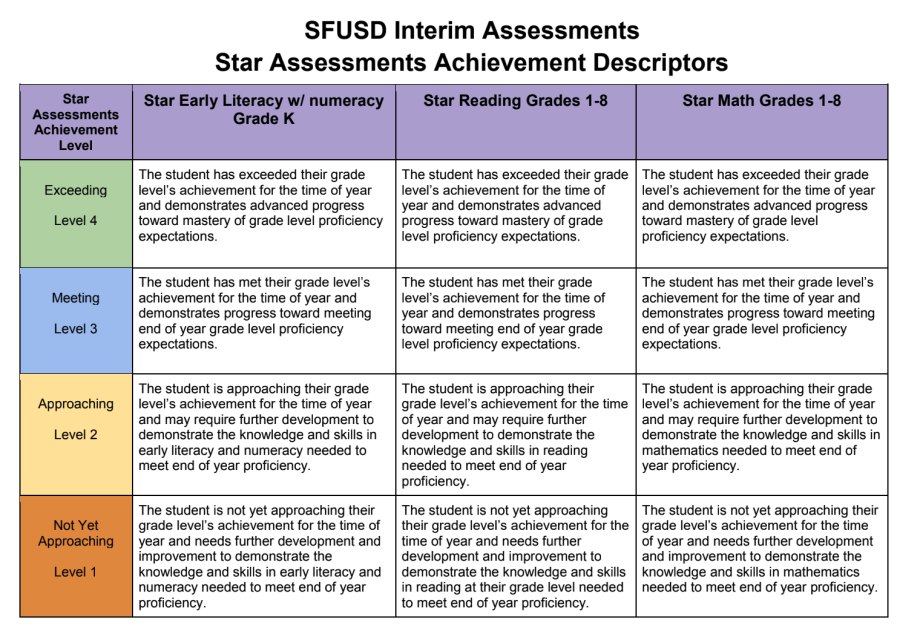
What does the color coded achievement level mean?
The achievement level describes the student's achievement relative to grade level criteria at the time the Star test is taken. NOTE: Standards Based Report Cards are scored to show where the student is relative to the end-of-year expectations. A student may score proficient on the Star assessment at this point in time, but they may not yet be meeting end-of-year expectations on their report card.
Translated descriptions of each Achievement Level shown below are available in this folder.
How can I best support my child for the District Assessment administration?
Here are some ways that families can support students with the District Assessments:
Before
- Teachers may share areas of strength or need they see in your child.
- Partner with your child's teacher to leverage areas of strength in addressing areas of need at home.
During
- Each student will complete the assessment independently.
- Teachers will monitor students to address issues of technology or directions that could affect student performance.
After
- Partner with your child’s teacher about the results of the test to better understand what you can do to support your child’s learning at home.
This page was last updated on September 2, 2026