

Overview Link to this section

We each develop at our own pace, so it's impossible to tell exactly when a particular student will reach a specific milestone or learn a given skill. The developmental milestones below will give you a general idea of the changes you can expect as each three, four, and five year-old gets older, but don't be alarmed as each student takes a slightly different course. Honor where they are and support them as they develop.
Three
Link to this section
Perceptual and Motor Development
- Children can quickly and easily combine the information received from the senses to inform the way they interact with the environment
- Walk and run with skill, changing speed and direction
- Kick and throw a ball, but with little control of direction or speed
- Bend over to pick up a toy and stand up without trouble
- Pedal a tricycle
- Jump up with both feet at the same time
- Walk up stairs, without holding on, placing one foot on each step
- Children coordinate the fine movements of the fingers, wrists, and hands to skillfully manipulate a wide range of objects and materials in intricate ways. Children often use one hand to stabilize an object while manipulating it
- Use child-safe scissors in one hand to make snips in a piece of paper
- String large wooden beads onto a shoelace
- Open a door by turning the round handle
- Use thumb, index, and middle fingers to draw or write with a crayon, marker, or pencil
Social and Emotional Development
- Participate in storytelling with teacher
- Tell a teacher from the classroom next door about an upcoming birthday party
- Ask a classroom visitor her name
- When exploring the environment, from time to time children reconnect, in a variety of ways, with the adult(s) with whom they have developed a special relationship: through eye contact; facial expressions; shared feelings; or conversations about feelings, shared activities, or plans. When distressed, children may still seek to be physically close to these adults
- Engage in simple cooperative play with peers
- Communicate with peers while digging in the sandbox together
- Have developed friendships with a small number of children in the group and engage in more complex play with those friends than with other peers
- Exhibit sadness when the favorite friend is not at school one day
- Identify their feelings, needs, and interests, and identify themselves and others as members of one or more groups by referring to categories
- Claim everything as “mine.”
- Show an understanding of their own abilities and may refer to those abilities when describing themselves
- Express complex, selfconscious emotions such as pride, embarrassment, shame, and guilt. Children demonstrate awareness of their feelings by using words to describe feelings to others or acting them out in pretend play
- Understand that other people have feelings that are different from their own and can sometimes respond to another’s distress in a way that might make that person feel better
- Anticipate the need for comfort and try to prepare themselves for changes in routine. Children have many self-comforting behaviors to choose from, depending on the situation, and can communicate specific needs and wants
- May sometimes exercise voluntary control over actions and emotional expressions
- Name own feelings or desires, explicitly contrast them with another’s, or describe why the child feels the way he does.
Communication and Language
- Demonstrate understanding of the meaning of others’ comments, questions, requests, or stories
- Communicate in a way that is understandable to most adults who speak the same language they do. Children combine words into simple sentences and demonstrate the ability to follow some grammatical rules of the home language
- Engage in back-and-forth conversations that contain a number of turns, with each turn building upon what was said in the previous turn
Cognitive Development
- Demonstrate an understanding of cause and effect by making predictions about what could happen and reflect upon what caused something to happen.
- Make a prediction about what will happen next in the story when the teacher asks, “What do you think will happen next?”
- Answer the teacher when she asks, “What do you think your mom’s going to say when you give her your picture?”
- Can predict how things will fit and move in space without having to try out every possible solution, and show understanding of words used to describe size and locations in space.
- Reenact multiple steps of others’ actions that they have observed at an earlier time
- Anticipate the series of steps in familiar activities, events, or routines; remember characteristics of the environment or people in it; and may briefly describe recent past events or act them out.
- Engage in make-believe play involving several sequenced steps, assigned roles, and an overall plan and sometimes pretend by imagining an object without needing the concrete object present
- Sometimes demonstrate the ability to pay attention to more than one thing at a time
Early Literacy and Across the Curriculum
Early Literacy
Interest in Print - Expect from children this age
- Enjoy both being read to and looking at books by themself
- Pretend to read books to stuffed animals by telling a story that is related to the pictures and turning the book around to show the picture to the stuffed animals, just as the infant care teacher does when reading to a small group of children
- Talk about the trip to the library and ask about the next trip
- Recite much of a favorite book from memory while “reading” it to others or self
- Try to be careful with books
Across the curriculum provide children with opportunities to
Four
Link to this section
Physical Development
- Visual focus is on faraway objects; have trouble with close visual activities, such as reading and writing
- Can't switch smoothly between near and far focus; have a hard time copying from the board
- Fine motor skills not well developed yet; awkward with writing, handcrafts, and other small movements
- Learn more through large muscle activity and constructive play, such as stacking large blocks that through desktop paper-and-pencil activities
- Often clumsy; collisions and spill are common; teaching cleanup techniques supports independence
- Energetic and active; need time for running, jumping, climbing and dancing
Social and Emotional Development
- Friendly, talkative, "bubbly"; love being with friends, though they still often work near, not with, a friend
- Love learning to work together; "Who's the boss?" is often a major developmental issue; can learn basic turn-taking skills, but the teacher saying "It's the rule" works wonders, too
- Not overly dependent on adults and can make choices based on their own interests; usually make good use of adult suggestions
- Need adult help finding words to express needs instead of reacting physically; teacher language is very important in helping childre use language instead of physical means: "If you want her to give you the toy, say 'I want you to give me the toy.'" "If you want a turn, you can ask, 'Can I have a turn?'".
- Easily redirected from inappropriate behavior (for example, to a child rushing for the stairs: "Jessie, please stop."; need teacher redirection and modelling of appropriate behavior and chances to practice ("Remember to go down the stairs slowly. That's safe. Watch how I do it, then you try". Teacher follows up with a positive descriptive acknowledgement (PDA) when Jessie walks down the stairs slowly; "Wow! You're walking down the stairs slowly! You're being safe.")
- Small dramas and role-plays let by the teacher help teach social skills (for example, how to take turns)
- Love school "jobs", such as taking attendance or putting out snack
Communication and Language
- Very talkative
- Imaginative; love dress-up and drama; enjoy experimenting with language, delighting in big words, long explanations, bathroom language, swear words
- Enjoy being read to, whether individually, in small groups, or as a whole class; love to do their own "reading" of picture books
Cognitive Development
- Have short attention spans; move quickly from one thing to another; hard for them to stay in one area of the classroom for an extended time
- Learn best by moving large muscles; need to play and explore
- Can learn responsibilities that are carefully taught, such as room cleanup at the end of a work period, but need the teacher to model expectations
- Constantly reading their environment; labeling objects that children frequently see or use gives them many opportunities to practice
Early Literacy and Across the Currciulum
Reading-Provide opportunities for children this age to:
- Be read to, especially from picture books with repetitive words.
- Be storytellers as well as listeners, working together in a small group with an adult to sequence events in a familiar story to change the story to add their ideas
- Do "parallel" reading with an adult: The child "reads one page of a familiar book (tells the story while looking at the words and pictures), and the adults reads the next
- Build the sequences of reading by listening to or parallel reading books with repeating phrases and few words or pictures and no words.
Writing-Expect from children this age:
- Writing Very little paper-and-pencil work focused only on mechanical skills; instead fours benefit from a focus on building early literacy skills through scribbling and using invented spelling
- Writing themes Fascination with blood and gore, fantasy, TV takeoffs, fairy tales and pets
- Handwriting Mainly scribble writing and drawing; typically grasp pencil in whole fis and use their arm, hand, and fingers as a single unit; young fours may hold pencil more tentatively toward the eraser and write with a very light stroke; older fours write more boldly and firmly; printing is usually large
- Beginning spelling Prephonemic - many letters do not correspond to sounds; for example, they might write or say "B-H-K-E-E-E-E-E-E-E-J-B" for sailboat.
Across The Curriculum-Provide opportunities for children this age to:
- Improve communication skills through imaginative play, such as on a puppet stage or in a dramatic play center
- Paint at stand-up easels with easy access to drying racks or clothesline hang-ups for finsished paintings; this supports development of large motor skills and the ability to visually represent learning in age-appropriate ways
- Use climbing apparatus on the playground; do tumbling activities in PE
- Get reading for writing by practicing with finger paints, chubby pencils, colored chalk on playgrounds
- Take part in organized recess games with an adult or older student leader
- Engage in activities that use music, rhythm, and repeating patterns
Five
Link to this section
Physical Devlopment
-

- Reverse letters and numbers, either swapping positions, as writing "ot" for "to," or drawing the letters themselves backward so that a "d" looks like a "b"; to help children become more self-aware, teachers can ask about the letter they reversed but not ask them to correct the reversal
- Find it hard to space letters, numbers, and words; using a finger as a separator helps
- Visual focus is on objects close at hand; still have difficulty copying from the board
- Need lots of physical activity; love indoor and outdoor physical play and activity, including lively games.
- Better control of running, jumping, and other large movements
- Staying focused in structured physical education classes can be difficult
- Often fall or slip out of chairs sideways
- Usually pace themselves well; will generally rest before they're exhausted
- May prefer to work standing up; some schools are now providing some stand-up desk spaces
- Still awkward with writing, handcrafts, and tasks requiring small movements
- Hold pencils with a three-fingered, pincer-like grasp; may need a pencil grip to help them relax
- Ready to begin learning manuscript printing; not always able to stay within lines
Social and Emotional Development
-

- Older fives may challenge adult authority and seem oppositional at times
- Want verbal permission from adults; can pace themselves while doing a given task but may need to be released to move from task to task; before acting, will ask "Can l...?"
- Need consistent routines, rules, and discipline; respond well to clear and simple expectations, such as "I will always ring the chime just once, which means put down what's in your hands and look at me"
- Can sit and work at quiet activities for fifteen to twenty minutes at a time, particularly tasks with manipulatives such as pretend or real money, counting cubes, attribute blocks, and other concrete objects
Communication and Language
-
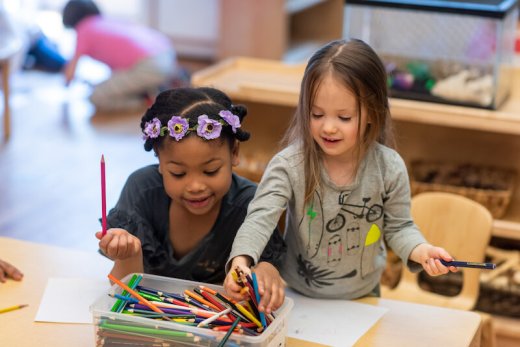
- Younger fives express themselves in few words; "play" and "good" are favorites
- More complex in their imaginative expression than fours; like to express themselves through words, drawing, and drama
- Often read aloud even when asked to read silently
- Older fives like to explain things and have things explained to them; will often give elaborate answers to questions
Cognitive Development
-
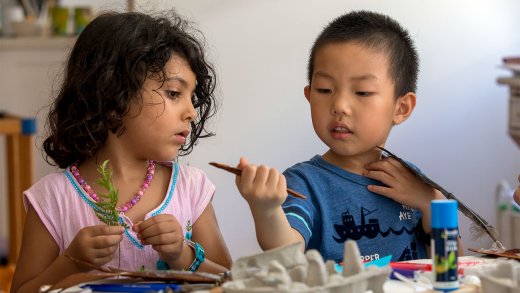
- Often see only one way to do things; rarely see things from another's viewpoint
- Not ready to understand abstract concepts such as "fairness"; the teacher will have to provide lots of examples as the year progresses: "Each one of you gets the help you need to learn new things - this is how I will be fair to everyone in our classroom"
- Imagination can be vivid, which can lead to believing toys and other objects are actually alive
- Learn best and express thoughts through active play, repetition, copying, and hands-on exploration of materials such as manipulatives, clay, sand, and water
- Think intuitively rather than logically; for example, "It's windy when the trees shake, so the trees must make the wind"
- Like to copy and repeat stories, poems, songs, and games, sometimes with minor variations; enjoy sets of similar math and science tasks
- Can become stuck in repetitive behavior (for example, always drawing rainbows or flowers) for fear of making mistakes when trying something new
- May still "talk their thoughts" out loud; for example, saying "I'm going to move the truck!" before doing so (more typical at four)
- Do best learning with predictable daily schedules reviewed each morning and carried out with a minimum of transitions; need clear routines for these transitions; as much as possible make sure the key events in the day, such as snack, art, and closings circle, happen in the same place, and at the same time
Reading, Writing, and Across the Curriculum
Reading - Provide opportunities for children this age to:
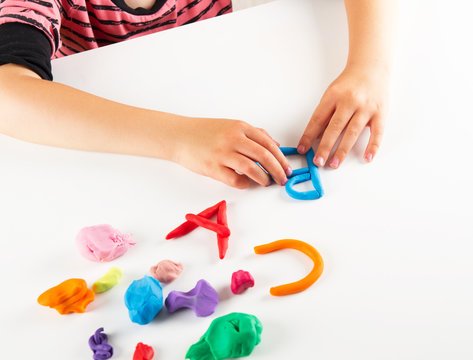
- Vocalize while they read or read out loud quietly to themselves, rather than being expected to do sustained silent reading
- Do "partner" reading - peers helping each other through familiar books; both need to play an active role (as in "parallel" reading)
- Have short chapter books read to them sometimes by readers from older classrooms
- Write stories or reports with a partner or small group of classmates and turn them into books for the classroom library
- Strengthen their reading skills by reading predictable books (books with few words, much repetition, and many pictures)
- Engage in regular systematic and targeted phonics instruction
- Create labels, signs, posters, and charts identifying familiar objects in their environment, such as areas of the room, use of shells, etc.
Writing - Expect from children this age:
- Writing: Labeling of drawings with initial consonants or vowels to stand for one feature in the drawing (as in "H" for "house" in a drawing of houses, people, and trees); tell stories in a single drawing and one or two words
- Beginning Spelling: Largely pre-phonemic or early phonemic -- beginning to use initial consonants or vowels to represent words and sometimes stringing those initial letters together in "sentences" such as I STBFL (I see the butterfly)
- Writing Themes: Family, family trips, fairy tales, tales of good and evil, stories about pets, and stories about themselves and best friends
- Handwriting: Switch to a three-fingered pencil grasp; tendency to write only uppercase letters; as an understanding of spelling develops, use of irregular spacing between words
Across The Curriculum - Provide opportunities for children this age to:
- Take risks and try new things through teacher structured daily challenges, such as drawing a forest without flowers or drawing a rainbow vertically on the page; ask them for ideas as well.
- Take part in active structured playground games in PE, at recess, or in the regular classroom.
- Practice making controlled small movements through simple activities such as weaving, tying shoes, and tracing mazes.
- Learn and practice language skills through teacher modeling, directed role-play, and dramatic play.
- View and draw simple three-dimensional blocks or shapes from different sitting positions to help them see things from different points of view.
This content on development comes from Yardsticks: Child & Adolescent Development by Chip Wood and the California Department of Education's Infant/Toddler Learning & Development Foundations. It has been lightly adapted to better reflect the language usage and practices of SFUSD.
This page was last updated on May 25, 2023