

Overview Link to this section
Learning and thinking are as much a collective enterprise as they are an individual endeavor. Create many opportunities for students to engage in partner, small group, and whole-class collaboration through play, exploration, and group-worthy cooperative tasks.
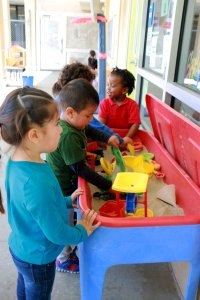
Support students in navigating lifelong questions of: 'Who am I and how do I connect and learn with others who are different from me?' 'How do I solve problems with my peers?' and 'How do I learn about and function within various contexts?'. Include regular opportunities for students to build on each other’s thinking and routines for navigating what to do when disagreement or conflict arises. Scaffold students’ ability to give and receive constructive feedback.
Supporting Collaboration Link to this section
Think, Pair, Share
This routine encourages children to think about something, such as a problem, question, or topic, and then articulate their thoughts.
Conflict Resolution Strategies
This conflict resolution strategy is from the California Teaching Pyramid Framework and is an example of a collaborative strategy. This is a strategy that must be taught to the children while they're not having any conflicts and then teacher facilitated when a conflict arises.
Small Group Learning
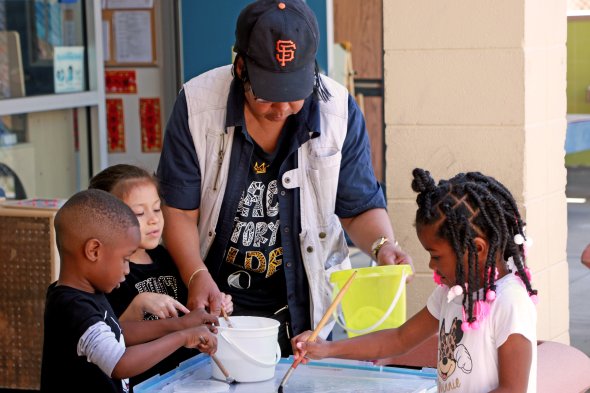
Small group learning provides opportunities for teachers to facilitate collaborative learning. Children come to the classroom with different strengths, interests, experiences, and needs. Small group learning allows you to meet children where they are, introducing ideas and activities that are just the right level of challenge for each child. Back-and-forth conversations are much easier to foster in small groups, and they allow you to ask questions based on individual children’s imaginations and understandings.
Standard-Based Skills: Students will be able to...
- Demonstrate curiosity and raise simple questions about objects and increased ability to raise questions events in their environment.
- Observe objects and events in the environment and describe them.
- Use language to communicate with others in familiar social situations for a variety of basic purposes, including describing, requesting, commenting, acknowledging, greeting, and rejecting.
- Attend to English oral language, in both real and pretend activity, relying on intonation, facial expressions, or the gestures of the speaker.
- Use accepted language and style during communication with both adults and children.
- Use language to construct short narratives that are real or fictional.
- Understand and use increasingly complex and longer sentences, including sentences that combine two phrases or two to three concepts to communicate ideas.
These standards are taken from Pre-Kindergarten standards found within the Preschool Learning Foundations volume 1 and volume 3 (Language and Literacy, Science, ELD)
Reflection Questions Link to this section
- How can collaboration develop academic ownership and honor students' experiences?
- What does collaboration currently look like in your practice? What is working well for students? How do you know?
- What are the implications for your own practice? What will you do first?
This page was last updated on May 22, 2023